YouTube MCP servers compared (2026): local vs hosted
By the YouTubeTranscriptAPI engineering team. Last updated October 27, 2026.
You asked Claude to summarize a YouTube video, and it said it can't watch videos. A YouTube MCP server fixes that, if you pick one that runs where your AI runs.
The best YouTube MCP server depends on where you use AI. Claude Desktop, Claude Code and Cursor can run a free local server on your own computer. Claude on the web, Claude on mobile and ChatGPT can only use remote servers, and Anthropic says Claude reaches those from its own cloud. YouTube blocks most cloud traffic, so for those apps you want a hosted server that handles YouTube for you.
We run one of the hosted servers in this comparison, so we've kept the table to facts you can check: GitHub stars, transport, sign-in and how each one gets transcripts.
What is a YouTube MCP server?
A YouTube MCP server is a small program that gives an AI app tools for YouTube, such as "get this video's transcript" or "search YouTube." It speaks the Model Context Protocol, which Anthropic introduced on November 25, 2024. The AI decides when to call a tool, the server fetches the data, and the text lands back in your chat as context the model can read.
Without one, the model only sees a link.
With one, it gets the words people said in the video, and it can quote, summarize or search them.
Anthropic said in December 2025 that there were more than 10,000 active public MCP servers and over 97 million monthly SDK downloads, according to its announcement about the Agentic AI Foundation.
YouTube is a crowded corner of that. When we queried the official MCP Registry on October 27, 2026, a search for "youtube" returned 91 servers, and 65 of them listed a remote endpoint.
So you have plenty of choice. The hard part is knowing which ones will actually work in your setup.
What can you do with a YouTube MCP server?
With a YouTube MCP server connected, you can ask your AI to summarize a video, pull quotes with timestamps, compare what several videos say, or find a channel's videos on a topic and read them. The model picks the tools itself. A prompt like "summarize the top result for FastAPI background tasks" makes it search YouTube first, then fetch that video's transcript.
On our server, these prompts trigger these tools:
"Summarize this video in five bullet points," with a link, calls one tool: get_transcript, for 1 credit.
"What did this speaker say about pricing? Give me timestamps," asks for the transcript with timestamps, so each quote comes with an [m:ss] marker.
"Find @TED's talks about climate and compare their arguments," calls search_channel for 1 credit, then get_transcript once per talk the model decides to read.
"What did this channel post this week?" calls get_latest_videos, which is free.
The model decides how many calls to make. If you want to control spending, say how many videos to read: "read the top three, not more."
What's the difference between a local and a remote YouTube MCP server?
A local YouTube MCP server runs on your own computer and talks to your AI app over stdio, so it only works in apps that can start programs: Claude Desktop, Claude Code, Cursor and VS Code. A remote server runs on the internet at a URL, speaks Streamable HTTP, and usually signs you in with OAuth. Claude on the web, Claude on mobile and ChatGPT can only use remote servers.
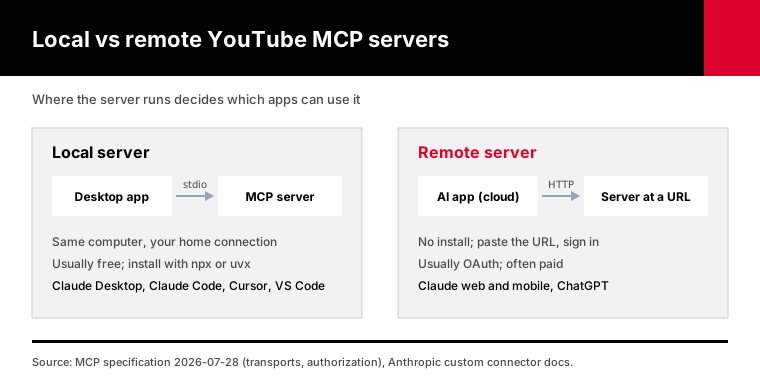
Most local servers are free and use your home internet connection. You install them with npx or uvx, and they run while your app is open.
Remote servers need no install. You paste a URL into your AI app, sign in, and the tools show up.
The protocol supports both on purpose. The MCP specification's authorization rules apply to HTTP transports and are based on OAuth 2.1, while stdio servers are told to read credentials from the environment instead.
If you only use Claude Code or Cursor on your laptop, a local server is a fine choice.
If you want YouTube in ChatGPT, or in Claude on your phone, local isn't an option at all.
Why do YouTube MCP servers fail with 429 or "Sign in to confirm you're not a bot"?
YouTube MCP servers fail when YouTube decides the traffic looks automated. Local servers can hit HTTP 429 rate limits or a "Sign in to confirm you're not a bot" check after heavy use. Self-hosted remote servers fail harder, because YouTube blocks most IP addresses that belong to cloud providers, and a remote server lives on exactly those addresses. A hosted service has to solve that problem for you.
You can see this in the projects' own issue trackers.
The kimtaeyoon83 server, the most-starred transcript server we checked, has an open issue titled "HTTP 429 (too many requests) with Claude", opened on September 30, 2026.
The anaisbetts server, which runs yt-dlp on your machine, has an issue titled "Sign in to confirm you're not a bot".
The jkawamoto server's README puts it plainly: "YouTube aggressively blocks automated transcript requests from cloud providers and data center IPs."
This is why "just host the open-source server yourself" goes wrong.
Anthropic's help page on custom connectors says Claude "connects to your remote MCP server from Anthropic's cloud infrastructure, rather than from your local device." Your self-hosted server would run on a cloud VM, and YouTube treats that VM like any other data center.
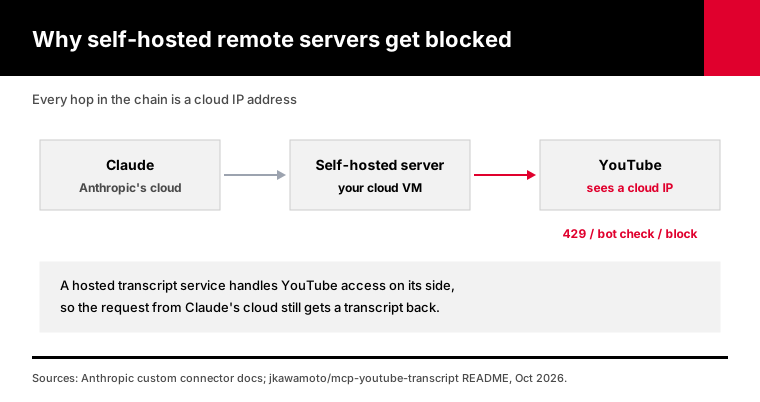
A hosted transcript service gets around this on its side. That work is the main thing you're paying for.
How do the main YouTube MCP servers compare?
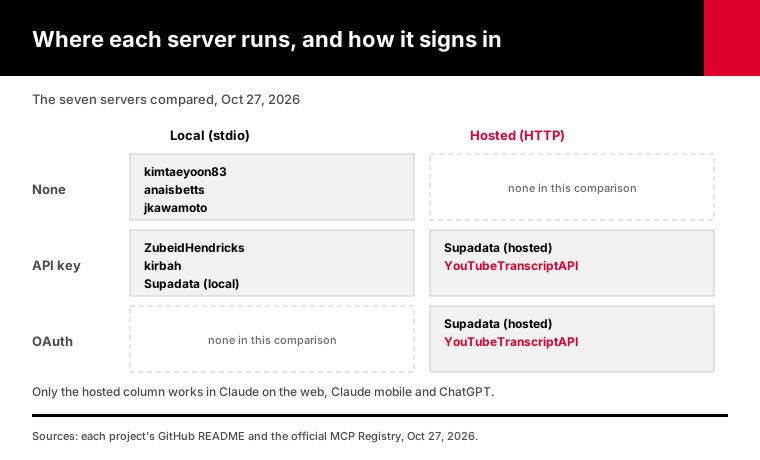
The main YouTube MCP servers split into free local servers and paid hosted ones. The four most popular local servers have 492 to 602 GitHub stars each and need no sign-in, but they only run in desktop apps and IDEs. Hosted servers such as Supadata and YouTubeTranscriptAPI work in Claude on the web and in ChatGPT, sign in with OAuth, and charge credits per call.
We checked these servers on October 27, 2026, and took the star counts from GitHub that day.
| Server | Runs | Sign-in | Gets transcripts from | Extra tools | Works in Claude web and ChatGPT | Cost |
|---|---|---|---|---|---|---|
| kimtaeyoon83/mcp-server-youtube-transcript (602 stars) | Local | None | YouTube's internal endpoint | Timestamps, ad removal | No | Free |
| ZubeidHendricks/youtube-mcp-server (589 stars) | Local | YouTube Data API key | Data API plus an npm caption package | Search, channels, playlists | No | Free, uses your API quota |
| anaisbetts/mcp-youtube (552 stars) | Local | None | yt-dlp on your machine | None | No | Free |
| jkawamoto/mcp-youtube-transcript (492 stars) | Local | None | youtube-transcript-api and yt-dlp | Languages, video info | No | Free |
| kirbah/mcp-youtube (32 stars) | Local | Data API key, except for transcripts | youtube-transcript-plus | Comments, trending, channel stats | No | Free, uses your API quota |
| Supadata MCP (63 stars) | Local or hosted | API key, or OAuth when hosted | Supadata's hosted API | TikTok, Instagram, X, web scraping | Yes, hosted version | Credits, 100 free a month |
| YouTubeTranscriptAPI | Hosted | OAuth or API key | Our hosted API | Search, channel and playlist listings, new uploads | Yes | Credits, 100 free to start |
The local servers are mostly transcript-only. If you also want search or channel listings, the ZubeidHendricks and kirbah servers add them, but you'll need a Google Cloud project and a Data API key.
Maintenance varies. The kimtaeyoon83 server's npm package is still version 0.1.1 from November 29, 2024, even though the repo had commits in July 2026.
Long videos are a known weak spot. The anaisbetts server has had an open issue titled "video subtitles too long, task failed" since 2024.
Which YouTube MCP servers work in ChatGPT and Claude on the web?
Only remote YouTube MCP servers work in ChatGPT and in Claude on the web or mobile, because those apps can't start programs on your computer. You add the server's URL as a custom connector in Claude or a custom MCP server in ChatGPT, then sign in. In practice that means a hosted server, since a self-hosted one on a cloud VM runs into YouTube's blocks.
Claude makes this easy on every plan, with one catch.
Anthropic's custom connector page says remote connectors are available "for users on Free, Pro, Max, Team, and Enterprise plans," and that "Free users are limited to one custom connector."
ChatGPT has supported MCP tools since OpenAI announced developer mode on September 10, 2025, calling it "full MCP client support for all tools, both read and write," in a post on its developer forum.
ChatGPT has renamed this area more than once, from Connectors to Apps to Plugins. If you can't find it, look for Plugins at chatgpt.com/plugins.
With OAuth sign-in, you click Connect, log in, and approve. There is no key to paste into a chat app.
For the two big chat apps, the short list is the hosted options: Supadata's remote endpoint or ours.
What does the YouTubeTranscriptAPI MCP server do?
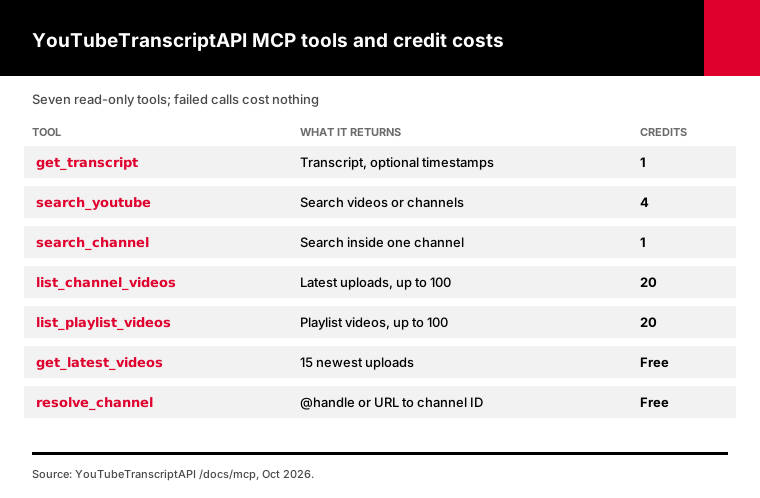
The YouTubeTranscriptAPI MCP server is a hosted remote server with seven read-only YouTube tools: transcripts, YouTube search, search inside a channel, channel and playlist listings, a channel's newest uploads, and handle lookup. It signs in with OAuth in Claude and ChatGPT, or takes an API key in IDEs. Each call costs the same credits as our REST API, and failed calls cost nothing, as the errors page lists.
Each tool and its price:
| Tool | What it does | Credits |
|---|---|---|
get_transcript | A video's spoken text, optionally with timestamps | 1 |
search_youtube | Search YouTube for videos or channels | 4 |
search_channel | Search one channel's videos for a topic | 1 |
list_channel_videos | A channel's latest uploads, up to 100 | 20 |
list_playlist_videos | The videos in a playlist, up to 100 | 20 |
get_latest_videos | A channel's 15 newest videos | Free |
resolve_channel | Turn an @handle or URL into a channel ID | Free |
Long videos come back in parts of 60,000 characters by default. Later parts, and reading the same video again within 24 hours, cost nothing, according to the MCP docs.
Every result ends with the credits you have left, so the model can tell you before a big job runs dry.
We checked the sign-in flow from the outside on October 27, 2026. An unauthenticated request to the server returns HTTP 401 with a header pointing to its OAuth metadata, which supports PKCE with S256 and client metadata documents, as the 2026-07-28 MCP specification recommends.
The server is listed in the official MCP Registry as com.youtubetranscriptapi/youtube.
Listings stop at 100 videos per call. For bigger channels, our guide to getting YouTube channel transcripts in bulk shows how to reach older videos with channel search.
How do you add a YouTube MCP server to Claude, ChatGPT or Cursor?
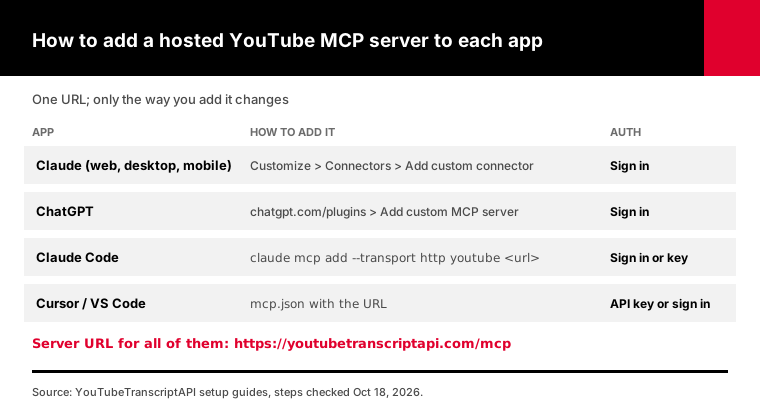
To add a hosted YouTube MCP server, paste its URL into your app's connector settings and sign in. In Claude, open Customize, then Connectors, then Add custom connector. In ChatGPT, open chatgpt.com/plugins and add a custom MCP server. In Claude Code, run one claude mcp add command. In Cursor, add the URL to mcp.json with an API key or sign in when asked.
Our server's URL is https://youtubetranscriptapi.com/mcp.
For Claude Code, the whole setup is one line:
claude mcp add --transport http youtube https://youtubetranscriptapi.com/mcpFor Cursor, put this in ~/.cursor/mcp.json and set YTT_API_KEY in your environment:
{
  "mcpServers": {
    "youtube": {
      "url": "https://youtubetranscriptapi.com/mcp",
      "headers": { "Authorization": "Bearer ${env:YTT_API_KEY}" }
    }
  }
}
In Claude and ChatGPT you don't need a key at all. You click Connect, sign in, and approve access.
Our Claude setup guide has screenshots for each step, and the YouTube MCP server page lists the other apps.
Then test it with a real request: "Get the transcript of this video and list the three main points," with a link.
Is a YouTube MCP server safe to connect?
A YouTube MCP server is safe to connect when its tools are read-only and you can revoke its access. Every tool on our server is marked read-only, so it can't post, delete or change anything on YouTube or in your account. When you connect with OAuth, the connection gets its own API key, which you can revoke from your dashboard at any time.
Local servers are a different trade.
They run on your computer with your user's permissions, because your AI app starts them with npx or uvx. That's normal for MCP, but it means you're running someone else's code.
Check that a local server's repo is active before you install it. Open issues from the last month tell you more than a star count does.
Hosted servers see the requests you send them: video links, search terms and the transcripts they return. They don't see the rest of your chat.
On our server, failed calls don't use credits, and the dashboard shows each connected app so you can disconnect one without touching the others.
Which YouTube MCP server should you choose?
Choose by where you work and how much you'll use it. For occasional use in Claude Desktop, Claude Code or Cursor, a free local server like jkawamoto's or kimtaeyoon83's is enough. For ChatGPT, Claude on the web or mobile, or a team, pick a hosted server. For channel listings, search and transcripts in one place, pick a hosted server with those tools.
If you watch the occasional conference talk and live in Claude Code, start local. It's free, but keep it light: in our own test on October 23, 2026, a home connection was rate-limited after 48 transcript requests in under 15 minutes.
If you want YouTube in ChatGPT or on your phone, local servers are out, so the choice is between hosted services.
If you do research across whole channels, transcript-only servers will feel thin. You'll want listing and search tools so the model can find videos on its own.
If you run agents on a server, treat it like the ChatGPT case. Your agent's cloud IP will meet the same YouTube blocks as a self-hosted MCP server.
Cost-wise, a transcript on our server is 1 credit. Our pricing page shows what 1,000 credits cost on each plan, and new accounts start with 100 free.
Frequently asked questions
Can Claude watch YouTube videos?
Claude can't watch video, but with a YouTube MCP server it can read a video's transcript. Connect a remote YouTube server as a custom connector in Claude, or add a local one to Claude Desktop or Claude Code. Then paste a YouTube link and ask for a summary, quotes or answers. The model works from the captions, so videos without captions can't be read this way.
What is the best YouTube MCP server for ChatGPT?
The best YouTube MCP server for ChatGPT is a hosted remote one, because ChatGPT can't run programs on your computer. Add the server's URL as a custom MCP server and sign in with OAuth. Supadata and YouTubeTranscriptAPI both offer hosted endpoints. Self-hosting an open-source server on a cloud VM usually fails, because YouTube blocks most cloud IP addresses.
Why does my YouTube MCP server return a 429 error?
A 429 error means YouTube is rate-limiting the requests your server sends. Local servers hit it after many transcripts in a short time, and servers on cloud IP addresses get blocked much sooner, as the jkawamoto project's README warns. The kimtaeyoon83 and jkawamoto projects both have open 429 issues in 2026. Slow down, run the server from a home connection, or switch to a hosted server that handles YouTube access.
Do I need a YouTube Data API key for an MCP server?
You only need a YouTube Data API key for servers built on Google's official API, such as ZubeidHendricks's or kirbah's server. Transcript-only local servers need no key, and hosted servers use their own account system instead. Google's official API also refuses caption downloads for videos you can't edit, so key-based servers fetch transcripts through a separate package.
Is a YouTube MCP server free?
Most local YouTube MCP servers are free and open source, and they run on your own computer. Hosted servers charge for usage: Supadata gives 100 free credits a month, and YouTubeTranscriptAPI gives new accounts 100 free credits, with 1 credit per transcript. Failed calls on our server cost nothing, and later parts of a long transcript are free for 24 hours.
How do I add a YouTube MCP server to Claude?
Open Customize in Claude, then Connectors, then Add custom connector, and paste the server's URL, such as https://youtubetranscriptapi.com/mcp. Click Connect and sign in to approve access. Free plans allow one custom connector. In Claude Code, run claude mcp add with the URL instead, and in Claude Desktop you can also run a local server.
Add YouTube to your AI app today
Pick the app you use most and connect a server in the next five minutes. For Claude or ChatGPT, add https://youtubetranscriptapi.com/mcp as a connector and sign in; new accounts start with 100 credits when you sign up. Then ask for a summary of a video you've been meaning to watch.
About the authors: we operate YouTubeTranscriptAPI, one of the hosted servers in this comparison, and we wrote the other entries from each project's own README, issues and listings, checked on October 27, 2026.